
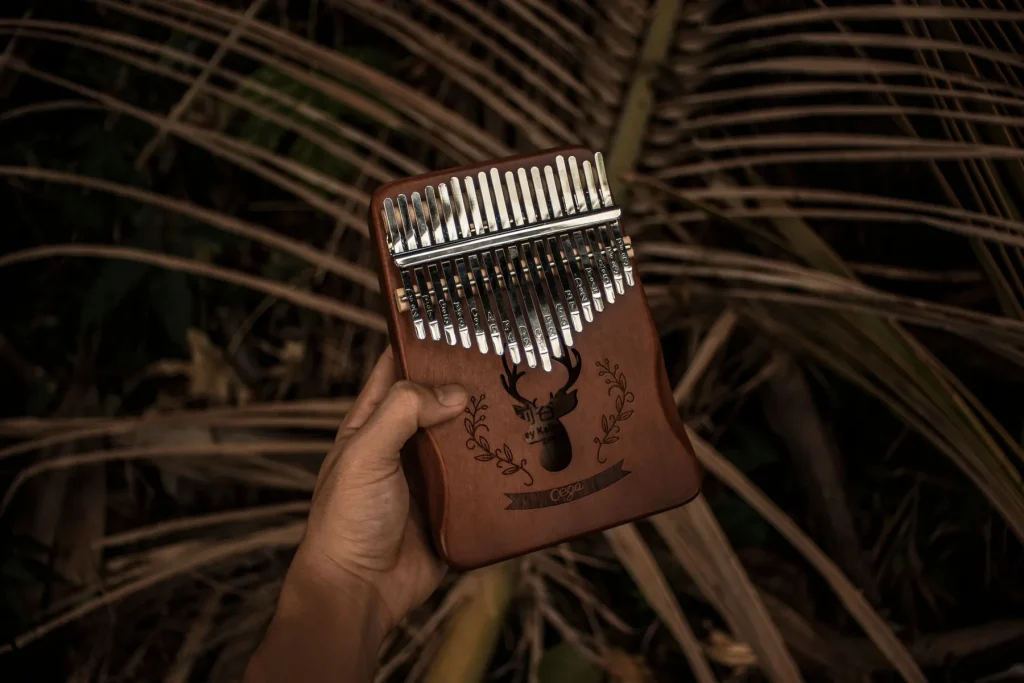
Can you play kalimba without nails? This is a common question for people who want to practice this instrument without necessarily having long nails. The good news is yes: it is possible to play kalimba without having long nails.
Having a few millimeters of nail extending beyond the pad of the thumb can be an advantage, but there are alternative techniques and accessories that can make up for it. Playing kalimba without nails may require some adjustment and may be less precise, but it is completely achievable with practice and solutions such as using the pads of your thumbs, silicone protectors, or picks. These tips help you get good sound quality and play comfortably, even without long nails.
In the rest of this article, we will also share other tips and techniques for playing kalimba without nails, to help you learn and practice this instrument in an enjoyable way that is accessible to everyone.
Sommaire
What should your nails be like to play kalimba well?
If you want to play kalimba well, it is important to take care of your nails. But that does not mean you need very long nails! In reality, the ideal length for playing kalimba is between 1 and 2 millimeters. Measure the distance between the top of the skin on your thumb and the tip of your nail, then adjust their length accordingly.
Along with length, the shape of your nails also plays a crucial role in the quality of your kalimba playing. Choose an almond or rounded shape, because it helps produce more precise sounds and prevents your nails from getting caught between the kalimba tines. Avoid square nails, which can be less effective for precise playing.
One warning, however: when you play kalimba, your nails may break. This depends on their strength and thickness. To help prevent breakage, you can apply a thin layer of polish to strengthen them. Another solution is to let them strengthen naturally by taking care of your diet and hydration.
To learn more about how to have the perfect nails for playing kalimba, read this article on the best tips for caring for a musician’s nails.
In short, to play kalimba well, it is important to find the ideal nail length, between 1 and 2 millimeters. Choose an almond or rounded shape, and strengthen your nails to avoid breakage. With well-maintained nails, you will be able to fully enjoy your musical experience with the kalimba.
Is it possible to play kalimba with large fingers?
Playing kalimba with thicker fingers can be a challenge for some people. The spacing between the tines can be narrow, which makes handling more difficult. However, do not worry: there are suitable solutions for people with large fingers.
Kalimba makers have taken this issue into account and created specific models for people with large fingers. Some kalimbas have tines split into two rows, giving wider fingers more room. This allows people with large fingers to play kalimba more easily and comfortably.
These models are designed so that the tines are spaced far enough apart to allow better access and an enjoyable playing experience for everyone, whatever their finger size. Whether your fingers are larger than average or you are simply looking for a roomier kalimba, these special models are there to meet your needs.
If you are interested in choosing a kalimba suited to larger fingers, you can read this practical guide. It explains useful buying and playing considerations for choosing a comfortable thumb piano.
| Advantages of playing kalimba with large fingers | Disadvantages of playing kalimba with large fingers |
|---|---|
| Better access for people with wider fingers | Possibility of touching several tines at the same time |
| Improved playing comfort | Less precision in your movements |
In conclusion, it is absolutely possible to play kalimba with large fingers thanks to models specially designed to provide more space between the tines. You do not need to let the size of your fingers stop you from enjoying this wonderful instrument. So do not let large fingers hold back your desire to play kalimba: go for it without hesitation!
What are the basic techniques for playing kalimba?
To play kalimba, there are several basic techniques that will help you produce harmonious notes and chords. Whether you use your nails or the pads of your thumbs, mastering these techniques is essential if you want a clear, precise sound.
The first technique is to use the tips of your nails to press the kalimba tines. By using the hardest part of your nails, you can create more precise and articulated sounds. Keep your nails well trimmed and clean to get the most from this technique.
Another technique is to use the pads of your thumbs to play kalimba notes. By using the fleshy side of your thumbs, you can get a softer, rounder sound. This technique is ideal if you do not want to use your nails or if you do not have long nails.
To practice, you can play successive notes using your left and right thumbs. By alternating between both thumbs, you can develop your coordination and dexterity. Start slowly, then gradually increase the speed to improve your fluidity.
Along with individual notes, you can also play chords on the kalimba. To play a chord, simply activate several keys at the same time. Experiment with different key combinations to create harmonious chords and explore new musical horizons.
Regular practice is essential for developing these techniques and improving your kalimba playing. With practice and perseverance, you will be able to play beautiful melodies and express your creativity.
To deepen your understanding of kalimba playing techniques, you can explore online resources. This guide will give you detailed information on how to read kalimba-specific sheet music and help you develop your musical skills further.
How do you read sheet music to play kalimba?
Knowing how to read sheet music or tablature for kalimba is essential for interpreting songs and melodies. Kalimba sheet music is often presented with stickers to make learning the notes easier. There are also online resources and guides for learning how to read kalimba-specific notation.
Kalimba sheet music is similar to sheet music for other musical instruments. It is made up of horizontal lines, called staves, on which notes and symbols are placed to indicate the pitch, duration, and rhythm of the sounds to play.
To learn how to read kalimba sheet music, it is useful to understand the symbols and signs that represent different notes and rhythms. Here are a few examples of commonly used symbols:
- Notes: notes on a score indicate the pitch of the sounds to play. They are represented by ovals placed on the lines or between the lines of the staff. Each note has a specific duration.
- Rests: rests are pauses in the music. They are represented by specific shapes placed on the staff. Rests indicate how long you should remain silent before playing a new note.
- Chords: chords are combinations of several notes played at the same time. They are represented by specific symbols that indicate the different notes to play simultaneously.
To learn how to read kalimba sheet music, it is best to start with simple scores and practice regularly. With experience, you will be able to read and play more complex music.
“Reading kalimba sheet music may seem difficult at first, but with patience and practice, you can acquire this skill and begin performing beautiful melodies.” – John Brown, musician.
To help you learn to read kalimba sheet music, you can use online resources such as video tutorials, free scores, and mobile apps. These tools can guide you step by step and provide practical exercises to help you improve.
In conclusion, knowing how to read kalimba sheet music is a valuable asset for any musician who wants to play this instrument. With practice and the right resources, you can master the art of reading sheet music and flourish in your kalimba practice.
Conclusion
In conclusion, it is absolutely possible to play kalimba without long nails thanks to alternative techniques and suitable accessories. The ideal nail length for playing kalimba is between 1 and 2 millimeters, giving you optimal precision without compromising playing comfort. For people with large fingers, there are kalimba models with tines separated into two rows, providing more space for easy playing.
The basic techniques for playing kalimba include using the nails or the pads of the thumbs to produce melodic notes and chords. Knowing how to read kalimba-specific sheet music or tablature can greatly make it easier to learn songs and melodies. By practicing regularly and using the right techniques, it is possible to play kalimba with satisfaction, even without long nails.
If you would like to learn more about the kalimba and what it can do, read this Instruments du Monde article, which is full of interesting information about this fascinating instrument: Everything You Need to Know About the Kalimba.