
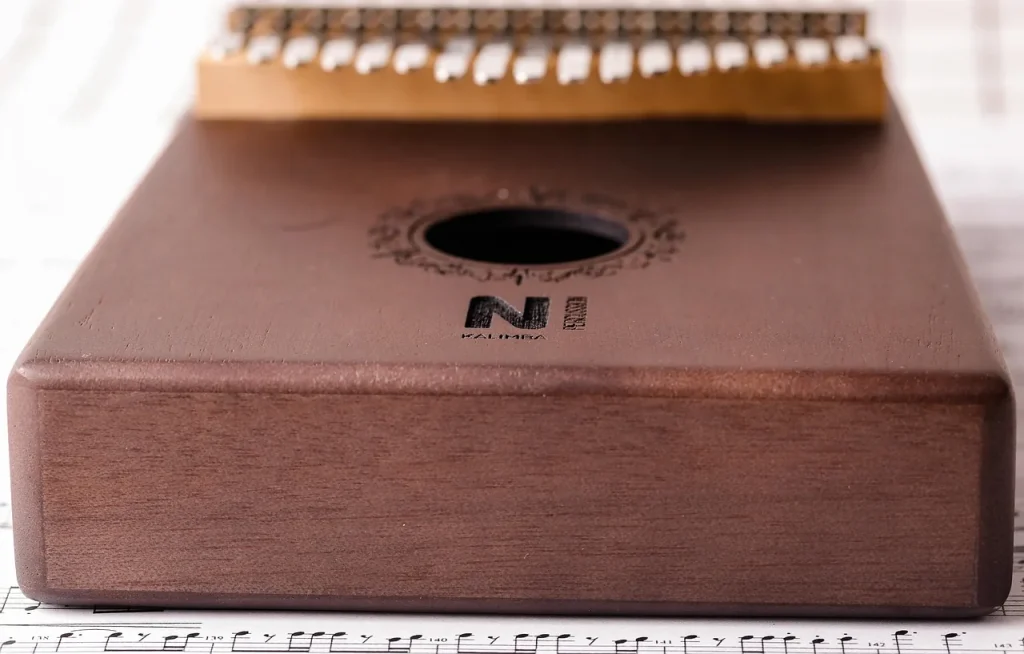
Also known as the mbira and the African thumb piano, the kalimba is a percussion instrument that is easy to play. Thanks to its metal tines attached to a resonating box, it produces a particularly soothing and very pleasant sound. If you know little about the kalimba, discover in this article the most impressive facts about this African musical instrument.
Sommaire
1. The kalimba: Zimbabwe’s national musical instrument
The mbira, or kalimba, is a traditional instrument of the Shona people of Zimbabwe. It is therefore inseparable from Zimbabwean culture. The Shona people played the kalimba both during rituals and in everyday songs. This musical instrument has deeply shaped Zimbabwean culture and society. Today, it has become a national instrument in Zimbabwe. Google honored it with a special animated Doodle, telling the story of how this culture has been preserved through the exploration of the kalimba.
2. A very ancient origin
The kalimba is almost as old as human history itself! Indeed, it appears to have existed for more than 3,000 years. Archaeological discoveries in Zambia, dating from 500 to 700 BC, revealed the presence of iron strips similar to those used to make the kalimba. This instrument, originally from Africa, may have been created twice: the first type is believed to have appeared on the continent’s west coast more than 3,000 years ago, while an identical version emerged many years later in the Zambezi River valley.
3. A sacred instrument for African peoples
An emblematic instrument of Shona culture, the mbira, or kalimba, is considered sacred throughout Africa. For African peoples, it plays a central role in religion. They regard it as an instrument given by the gods to help them stay in contact with their ancestors. Thus, during celebrations of major events such as weddings, and especially during funerals, the mbira was always present. People played their ancestors’ favorite songs, believing they could draw their spirits to the ceremony and communicate with them. It was also an instrument played for kings.
4. A musical instrument that is unique in every version
Did you know that kalimba is the name Hugh Tracey gave to the instrument in 1954, when he wanted to introduce this African musical instrument to the whole world? Originally, it was known as the mbira. As it spread across Africa, each ethnic group designed its own version and gave it its own name. The aim was to make its music unique. Each version therefore differs in its design, the number of keys, and the materials used to make it.
5. Any metal can be used for kalimba tines
A percussion instrument, the kalimba is made up mainly of tines. Although the earliest tines were made of bamboo, today almost any type of metal can be turned into kalimba tines. People who make their own kalimbas use sofa springs, car-seat springs, or even bicycle spokes. In short, any type of recycled steel can be used to create tines. For commercially sold models, stainless steel is the material most often used.
6. Magnets can change a kalimba’s tuning
Magnets have many uses, but you probably had not thought that they could change the tuning of a kalimba. By placing a magnet on a tine, the pitch of a note changes. This allows players to obtain additional notes such as sharps and flats. Use a tuner to find the best tunings and you will have more options when playing your kalimba.
7. An easy-to-learn thumb piano for everyone
A little practice and a good ear are enough to learn how to play a piece on a kalimba. In fact, learning can be great fun for both children and adults. The idea is to hold the instrument with both hands, pressing the tines with your thumbs while your middle and index fingers open or close the holes at the back of the box. You can then enjoy playing pieces that match your musical tastes.
8. The kalimba in popular songs
In David Bowie’s hit song Space Oddity, which charted in the United Kingdom, you can hear the kalimba at the beginning of the track, in the introduction and first verse. Phil Collins also plays the thumb piano in his song Long Long Way to Go, with Sting on backing vocals. In the 1970s, Maurice White, singer and leader of the funk band Earth, Wind and Fire, helped bring the instrument to a wider audience. Steve Hackett, the famous guitarist from Genesis, also used it on their album Wind and Wuthering. Naoya Sakamata, a Japanese artist, also chose the kalimba for her piece Kindness and Resonance.
9. The kalimba, an excellent instrument for music therapy
The kalimba is an excellent music therapy tool. The sound produced by the instrument is closer to that of a music box. It is also very close to the sound of a harp or a bell. The vibrations emitted by the kalimba are soothing, and its sounds appeal to both babies and children, who tend to calm down when they hear it. For adults, they help reduce stress by making it easy to relax quickly.
10. Perhaps the musical instrument with the most names in the world
In Europe, it is called a thumb piano or finger piano. In Africa, the name of the kalimba changes depending on the region and ethnic group. Although its true original name is mbira, this instrument is also called likembe, mbila, mbira, nhare, karimbao, marimba, karimba, matepe, njari, sansu, zanzu, okeme, ubo, sanza, gyilgo…