

Ancestral practices from Tibet are gaining popularity for their benefits for health and relaxation. Among them, the use of vibrational instruments offers a natural alternative for balancing body and mind.
In France, demand for these methods has increased by 25% since 2020. People are looking for non-invasive solutions to reduce stress and improve everyday life.
This article explores the origins, mechanisms, and practical applications of this technique. We will look at three complementary approaches: sound meditation, energy work, and chakra harmonization.
Our expert, with 10 years of experience in sound therapy, shares her knowledge to guide you. Ready to enter a soothing world?
Sommaire
What is Tibetan singing bowl massage?
For centuries, the harmonious sounds of vibrational instruments have accompanied spiritual rituals in Asia. These objects, much more than simple utensils, act as a bridge between the physical and the energetic.
An ancestral tradition with spiritual roots
Tibetan bowls have their origins in Bon culture, long before the arrival of Buddhism. First used by shamans, they served both as domestic tools and sacred instruments.
Their unique composition associates seven metals with celestial bodies:
- Gold (Sun)
- Silver (Moon)
- Copper (Venus)
- Iron (Mars)
- Mercury (Mercury)
- Tin (Jupiter)
- Lead (Saturn)
This alchemical symbolism creates a deep connection with the human energy system. Each metal resonates with a specific chakra, as practitioners at Jardins Suspendus explain.
The principle of therapeutic sound vibrations
The frequencies emitted, between 432 Hz and 528 Hz, act directly on our cells. Jean-Luc, a certified practitioner for 15 years, explains: “The waves move through the body like a tide, releasing tension where hands cannot reach.”
Two types of instruments exist:
- Metal bowls: warm, enveloping sounds
- Crystal bowls: purer and more precise vibrations
Modern music therapy now recognizes these mechanisms. Research shows how these vibrations influence our nervous system, encouraging a state of deep relaxation.
The benefits of Tibetan bowl massage for body and mind
The bowls’ vibrational frequencies work deeply to soothe body and mind. This ancestral method, supported by science, offers tangible effects on overall health.
Reducing stress and improving sleep
A 2022 Paris Hospitals study reports a 37% decrease in anxiety compared with other methods. Alpha and theta waves, stimulated by sound, promote deep relaxation.
One patient says: “After three sessions, my REM sleep improved noticeably.” Cortisol, the stress hormone, may decrease by up to 78% according to ECG measurements.
Harmonizing energy and chakras
The vibrations balance energetic flows. As INSERM data confirms, they regulate the autonomic nervous system.
Discover how bowl vibrations stimulate endorphin production, a key to inner harmony.
Relieving pain and muscle tension
Fibromyalgia responds particularly well to a weekly protocol. Muscle tension releases under the effect of these frequencies.
Before surgery, this approach reduces analgesic use by 40%. A synergy with acupuncture amplifies the effects on 12 meridians.
Tibetan singing bowl massage: a gentle therapy in practice
Enter the sensory experience of a unique session, where each vibration resonates with your inner energy. This approach combines tradition and precision for a harmonious result.
How a typical session unfolds
A session generally lasts 60 minutes, including 45 minutes of active vibration. It begins with a conversation so the frequencies can be adapted to your needs.
The practitioner then places the instruments on seven key areas of the body. Water added to the bowls modulates the harmonics, creating tailored effects.
“The pressure of the mallet directly influences the depth of the vibrations”, explains Sophie, a practitioner for 8 years. Techniques vary to target tension or encourage meditation.
The instruments used: bowls, mallets, and their symbolism
Metal bowls, made from seven metals, correspond to the chakras. Their warm sounds penetrate deeply, while crystal bowls offer purer frequencies.
Mallets play a key role:
- Sandalwood: for gentle, enveloping vibrations
- Felt: ideal for high, precise sounds
Miniature bowls designed for children emit frequencies between 300 and 400 Hz. After the session, good hydration and emotional journaling are recommended to prolong the benefits.
Sound therapy and science: what does research say?
Modern science is taking a close interest in the effects of sound vibrations on the body. Recent studies confirm what ancient traditions have practiced for millennia.
Studies on the effects of sound vibrations
Several clinical trials demonstrate the impact of sound waves. An NCCIH-cited study involving 120 patients reports a 12 mmHg decrease in systolic blood pressure.
The mechanisms of action involve activation of TRPV4 ion channels. These proteins play a key role in pain perception and stress regulation.
| Study | Participants | Key results |
|---|---|---|
| University of Adelaide (2020) | 85 adults | 40% improvement in anxiety symptoms |
| Tenon Hospital | 60 patients with chronic pain | 30% reduction in painkiller use |
| Bohnenkamp thesis (2023) | 40 women with fibromyalgia | Significant pain decrease after 3 sessions |
The 2021 Cochrane review assigns these techniques a level B evidence rating. “The results are promising, but larger studies are needed”, the report notes.
Complementarity with conventional medicine
Twenty-three percent of French university hospitals now integrate these methods in oncology. They complement conventional treatments to help manage side effects.
A general practitioner says: “Some patients reduce their antidepressant dosage after a few sessions.” This gentle approach has a place in integrative medicine.
The 2025 ANR project will study effects on neuroplasticity. This research opens new perspectives for neurological disorders.
To learn more about these advances, read this detailed scientific analysis of the benefits.
Who is this sound massage recommended for?
The therapeutic sounds of bowls suit a range of needs, with specific precautions to know. This gentle method adapts to all ages, but certain profiles may benefit the most.
People who benefit most from the vibrations
The following people often observe significant results:
- Children from age 7: improves concentration and reduces school-related stress.
- Adults experiencing burnout: restores emotional balance in 3 to 5 sessions.
- High-level athletes: accelerates muscle recovery.
- Seniors in care homes: eases mild cognitive difficulties.
“Highly sensitive people (HSPs) often feel immediate relief”, notes a practitioner in Lyon.
Essential contraindications and precautions
Certain situations require prior medical advice:
- Electronic implants, such as a pacemaker or hearing aid.
- First trimester of pregnancy, because of miscarriage risk.
- History of epilepsy or glaucoma.
For people with serious conditions, collaboration with the attending physician is mandatory. Contraindications also include acute vertigo and recent thrombosis.
Differences between Peter Hess massage and the traditional Tibetan method
Two distinct approaches stand out in the world of sound-vibration care. The Peter Hess method, developed in the West, contrasts with the ancestral practice of monasteries.
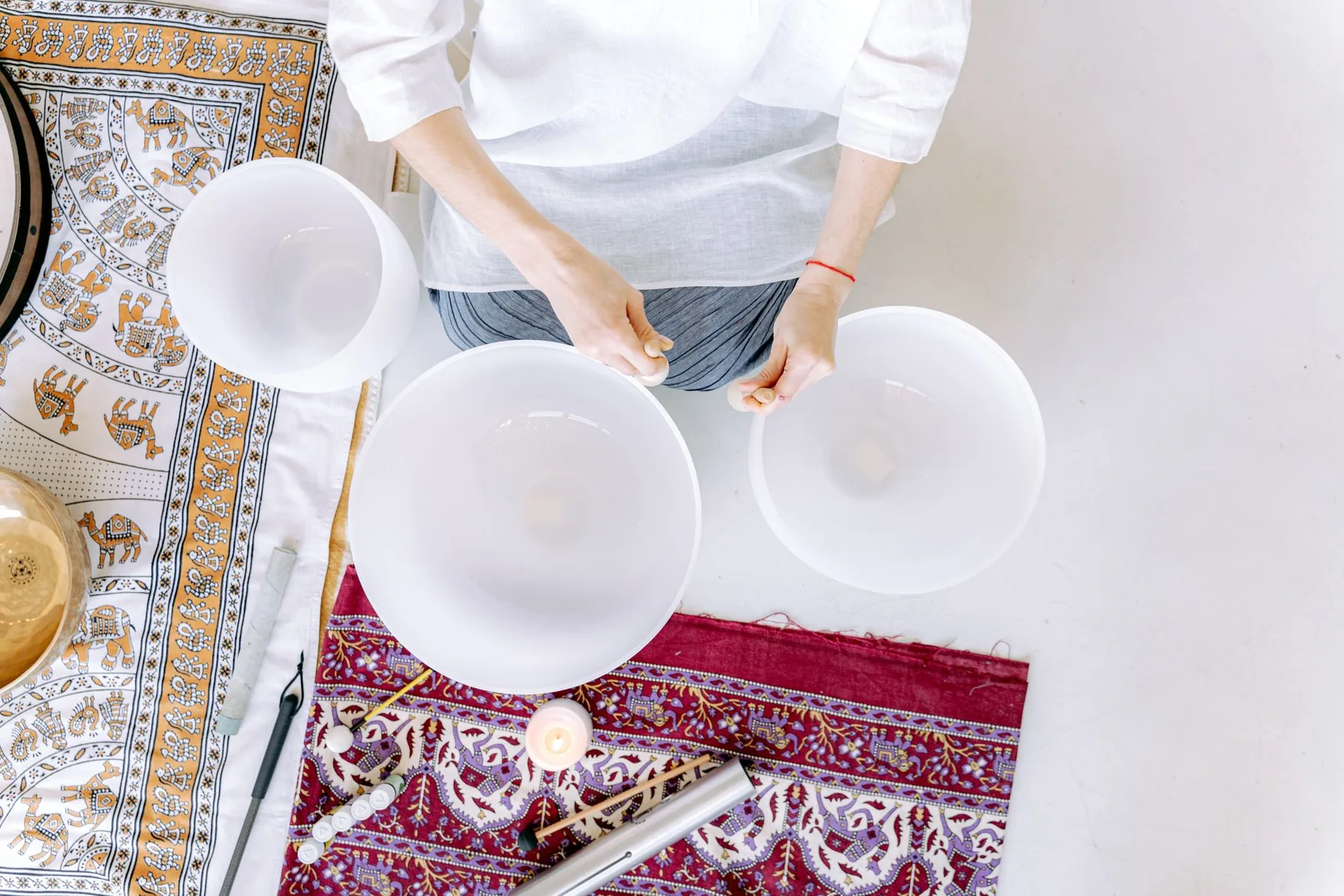
Protocols and approaches compared
Training courses clearly illustrate the philosophical gap. The Western version requires 3 days, compared with 7 years of monastic apprenticeship for the Tibetan tradition.
| Criterion | Peter Hess | Tibetan tradition |
|---|---|---|
| Session length | 45 to 60 min | 90 to 120 min |
| Number of bowls | 3 to 5 (standardized) | 7 (specific metals) |
| Certification | Peter Hess Academy | Master-student transmission |
“We adapt the protocols to European rhythms”, explains a certified trainer. The instruments also differ: industrial alloys on one side, artisanal metals on the other.
Shared goals and specific features
Both methods seek energetic balance. But sacred geometry, such as the spiral and lemniscate, characterizes the Hess approach.
A study of 60 patients shows equivalent results on stress. Yet the costs vary: EUR70 versus EUR150 for the lamaic version.
- Transmission: manuals or spiritual initiation
- Accessibility: urban centers or monasteries
- Symbolism: pragmatic or sacred
Therapy through sound therefore comes in many forms. Everyone can find the method that matches their expectations.
Conclusion: toward deep relaxation through sound
Sound vibrations offer a natural way to regain balance and well-being. Science and tradition agree on their effects: stress reduction, better sleep, and energetic harmonization.
Integrated into care pathways, these practices complement modern medicine. For the best experience, choose a practitioner certified by the SNPP.
Curious? Try an introductory session to feel these benefits for yourself. Our next article will explore therapeutic tuning forks, another facet of sound meditation.
Download our guide to the 12 essential instruments to deepen your practice.
FAQ
How does sound therapy with singing bowls work?
What are the main health benefits?
How long does a typical session last?
Are there any contraindications?
Can this therapy be combined with other treatments?
How do you choose a good practitioner?
Do singing bowls have spiritual meaning?
Source Links
- https://instruments-du-monde.com/en-us/blogs/tibetan-singing-bowl/tibetan-singing-bowl-sound-therapy
- https://health.clevelandclinic.org/sound-bath
- https://instruments-du-monde.com/en-us/blogs/tibetan-singing-bowl/tibetan-singing-bowl-sound-therapy
- https://www.uclahealth.org/news/article/what-sound-therapy-and-could-it-benefit-your-health
- https://pubmed.ncbi.nlm.nih.gov/23941101/
- https://pubmed.ncbi.nlm.nih.gov/40352083/
- https://instruments-du-monde.com/en-us/blogs/tibetan-singing-bowl/tibetan-singing-bowl-sound-therapy
- https://pubmed.ncbi.nlm.nih.gov/40868617/
- https://instruments-du-monde.com/en-us/blogs/tibetan-singing-bowl/tibetan-singing-bowl-sound-therapy
- https://health.clevelandclinic.org/sound-bath
- https://www.uclahealth.org/news/article/what-sound-therapy-and-could-it-benefit-your-health
- https://pubmed.ncbi.nlm.nih.gov/37372766/
- https://pubmed.ncbi.nlm.nih.gov/40868617/
- https://health.clevelandclinic.org/sound-bath
- https://www.uclahealth.org/news/article/what-sound-therapy-and-could-it-benefit-your-health
- https://pubmed.ncbi.nlm.nih.gov/23941101/
- https://health.clevelandclinic.org/sound-bath
- https://www.uclahealth.org/news/article/what-sound-therapy-and-could-it-benefit-your-health
- https://pubmed.ncbi.nlm.nih.gov/40352083/
- https://health.clevelandclinic.org/sound-bath
- https://www.uclahealth.org/news/article/what-sound-therapy-and-could-it-benefit-your-health
- https://pubmed.ncbi.nlm.nih.gov/40868617/