
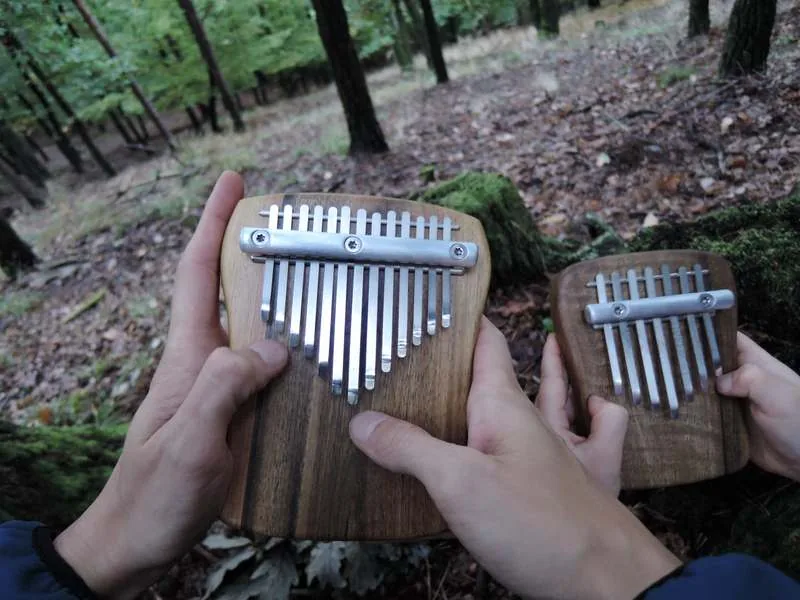
Do you love music and are you especially interested in musical instruments ? There are many models, suited to many kinds of music , and each instrument can produce a particular sound that is gentle on the ear.
You certainly already know many instruments such as the guitar, the piano, or the violin. Some categories are very popular, and we recognize their sound very easily.
But other instruments more often go unnoticed, even though they can produce delightful melodies, including some you may already have heard. It is important to broaden your knowledge of musical instruments from around the world. That is why we decided to present a complete article on the kalimba.
Have you already heard of this instrument ? Or have you already seen one during a performance? The kalimba is still fairly little known, but that takes nothing away from its originality. If you would like to learn more about this instrument, we invite you to read the rest of this article.
Sommaire
Introducing the instrument
First of all, it is important to know that the kalimba is a musical instrument also called a Mbira (or Mbila, Libemke, Marimba). You may therefore hear these different names. The kalimba belongs to the family of lamellophone instruments and percussion, although it is not very well known, especially in France.
It has tines of different sizes and shapes so that you can obtain different sounds when you play a piece of music. Its body is a support made of wood in the case of the classic kalimba.
The sound of this instrument is found mainly in African music, because this music accessory comes from Sub-Saharan Africa. If you have already listened to this kind of music, it is very possible that you have already heard the kalimba, with its low acoustic volume, which produces soft sounds and is therefore often used for small events.
The keys are therefore made of metal, and this instrument is played with the fingers by plucking the various tines in order to obtain sound vibrations that make it possible to play music harmoniously.
But the kalimba often remains a mysterious instrument for music lovers. Even if you can now picture what instrument it is, that does not necessarily mean you know its history and origin. We have therefore prepared a section devoted to its origins.
The origins of the “thumb piano”
First of all, it is important to get to know an instrument by understanding the meaning of its most common name. The kalimba is a Bantu name that literally means “a little music ”. This word originally refers to this particular instrument, but over time, the vocabulary became a generic name used to describe an instrument that works like a traditional thumb piano. But the kalimba can also refer to the original instrument, that is, the traditional African wooden lamellophone.
The history of the kalimba goes back many years. For example, traces of this instrument support the hypothesis that it was made in Zimbabwe more than 1,000 years ago. This instrument was gradually used for music performances and various ceremonies in Africa, such as the Bira spirit-possession ceremony, for example.
When we look at the history of the traditional kalimba, we discover that certain archaeological traces in Zambia revealed iron strips similar to those used on a kalimba. These very ancient traces are dated from 500 to 700 years BC. We can therefore suppose that it had a close ancestor before being used in the ceremonies we know today. But this discovery also allows us to think that the kalimba represents the original form of these ancient tines.
This musical instrument gradually developed in Africa before being exported around the world. The version most often pictured is Hugh Tracey’s, which helped popularize the Kalimba and appeal to Western audiences during the 20th century. Indeed, its creator took the time to introduce it to the rest of the world, and that is why we know this African instrument today. We therefore often think of it as an African object with an old history that is not always very clear. This share of mystery increases the attraction we feel for this instrument, and many people take an interest in this music !
But to get to know the kalimba better, it is important to understand how this wonderful instrument works. That is why we took the time to prepare a detailed explanation of how the kalimba works.
The structure of the kalimba
To succeed in playing a musical instrument, it is important to understand its structure. This will allow you to understand how the sound is produced, but also how to produce the right notes more easily.
In general, the kalimba is made up of a wooden structure, resonant tines, and a central bar that makes it possible to produce the desired sound by manipulating the different tines with your fingers.
The body of the kalimba is often made of wood, while being hollow and resonant, but flat models also exist. The resonance will vary depending on whether it is a flat board or a hollow box, but it is entirely possible to improve the resonance of the flat model if necessary, by placing it on a table, a piece of furniture, or a percussion cloth, for example.
When you use the different tines to create sound vibrations, you should not expect to be able to control the sound only from these rods. Indeed, sound control is achieved mainly at the hollow hole of the kalimba, which creates a different resonance depending on whether the opening is covered or not. Note that there is also an electric kalimba, which allows you to use a jack socket to improve the acoustics and resonance more easily.
How does a mbira / kalimba work?
Once you have learned to understand the structure of the electric kalimba and that of the traditional model, you will find it easier to use. You will quickly notice that there are many models on the market. The materials are different, and so is the size. For example, there is a Kalimba with 10 keys, and a Kalimba with 17 keys. The choice will depend on how it is used and on the sounds you want to produce.
It is therefore important to take the time to learn how the kalimba works before choosing the model that could match your wishes and needs.
To begin with, the Kalimba is composed of a certain number of blades with the same composition and the same width. The difference lies in the length of these blades, and it is this difference that allows you to create different musical notes when you press the metal with your fingers.
To play the kalimba, you must press the tine downward to cause resonance on the wooden body. But it is not this simple tine that creates the sound of your instrument; it is the installation inside the body that creates these different sounds, as well as the holes present at the back of the kalimba, which allow the sound to resonate and come out.
To play the electric kalimba or the traditional one, the musician simply has to hold the instrument in their hands and press the different tines. But one hand alone will not be enough for a Kalimba 10 keys or a Kalimba 17 keys. You therefore need to use both thumbs to divide the keys evenly into two groups.
When the thumbs press certain keys, the index finger or middle finger of those same hands acts harmoniously to open or close the holes at the level of the instrument’s body. This association of movements makes it possible to modulate the sounds by controlling the sound vibrations.
Although it is not easy to play the kalimba like an experienced musician at first, it remains a musical instrument that is simple to understand. Whatever keys are played, the melody will be harmonious and the notes in tune. This is what makes it a wonderful tool for taking part in children’s musical awakening.
You will need to practice in order to create the right sounds, starting by working on your coordination in the fingers of each hand. Poor coordination will prevent you from opening or closing the hole in the right way and at the right moment (note that this practice is optional and only comes after good mastery of the instrument).
You will therefore need to practice before trying to play an entire piece, but it remains much simpler than with many other instruments.
Using the kalimba and practicing
You now know the history, but also how the Kalimba works. You probably want to take the time to find an electric Kalimba and start learning this new African instrument.
There are a great many kalimbas for sale on the market. For example, you can start by turning to a Kalimba with 10 keys; this will give you fewer tines to master at first. But it is entirely possible to practice directly with a Kalimba 17 keys if you wish! Electric kalimbas exist at different prices depending on the materials used. We therefore advise you to take the time to compare several models, or to ask someone who already plays one for advice.
Once you have acquired your musical instrument, all that will remain is to practice until you manage to play a piece. We advise you to start with short pieces with few variations. This will allow you to concentrate over several sessions in order to get used to your new kalimba. It will also be a good way to work on your coordination between the fingers of the same hand, but also between your two hands.
To progress more quickly, we advise you to learn the organization of the notes on the kalimba. This will help you master this sonorous instrument more quickly.
The notes of the kalimba instrument
- Scales: This part will be fairly complex, so you should avoid starting with it during your first sessions. Notes that are close together in the scale are actually located on opposite sides of your kalimba.
- Chords: This part will be the easiest to integrate into your practice sessions, because chords are placed with two, three, or even four successive notes on your kalimba. You will therefore have no difficulty producing melodious sounds by making a chord with blades placed next to one another.
- Octaves: Octaves are the easiest to identify, because they are placed on opposite sides. This means they are accessible with one thumb at each end, one thumb on the left and one on the right.
You will therefore need to take into account the ease and the difficulty of the instrument before you begin learning it. You will find many tutorials on the internet, as well as explanations that will help you get to grips with your instrument more easily, so do not hesitate to do some research in order to progress faster.
Making a handmade Kalimba for the more practical-minded
Are you good with your hands and do you want to create your own kalimba ? This project is entirely possible if you have the raw materials and a few tools to help you.
Making your own kalimba will be a good way to understand its composition, but also the way the sound is produced from the different vibrations. This rewarding experience can therefore help you progress more quickly by learning to play on an instrument you designed yourself.
You will find a few tutorials on the internet that will allow you to make a kalimba quickly and easily with standard materials. The sound quality will not be as good as with an electric Kalimba or a professional production, but this original experience can allow you to discover the instrument before investing, for example.
However, do not embark on this project if you are not practical. Making a kalimba yourself is fairly simple if you are used to DIY, but it will be much simpler to invest in a ready-made kalimba if you have neither tools nor available materials.
You now know the kalimba in greater detail. Its mysterious history and origin have certainly made you want to begin learning this original musical instrument. This African-inspired music will allow you to introduce the kalimba to people around you very easily.
All that remains is to find your ideal instrument by choosing between a kalimba with 10 keys and one with 17 keys, for example. You will be able to find people who have mastered the electric Kalimba on social media to help you at the beginning, and this lovely community will welcome you very quickly.
All that remains is to practice and introduce this African-origin music at private events or small performances. You will quickly fall in love with this original instrument, still little known in Europe!
So do not wait any longer to begin this new adventure and to add a new instrument from the percussion family to your collection of musical instruments !
Do you want to improve with the Kalimba? Read our guide to playing this musical instrument better. Your level will improve considerably after you have read our tips.