
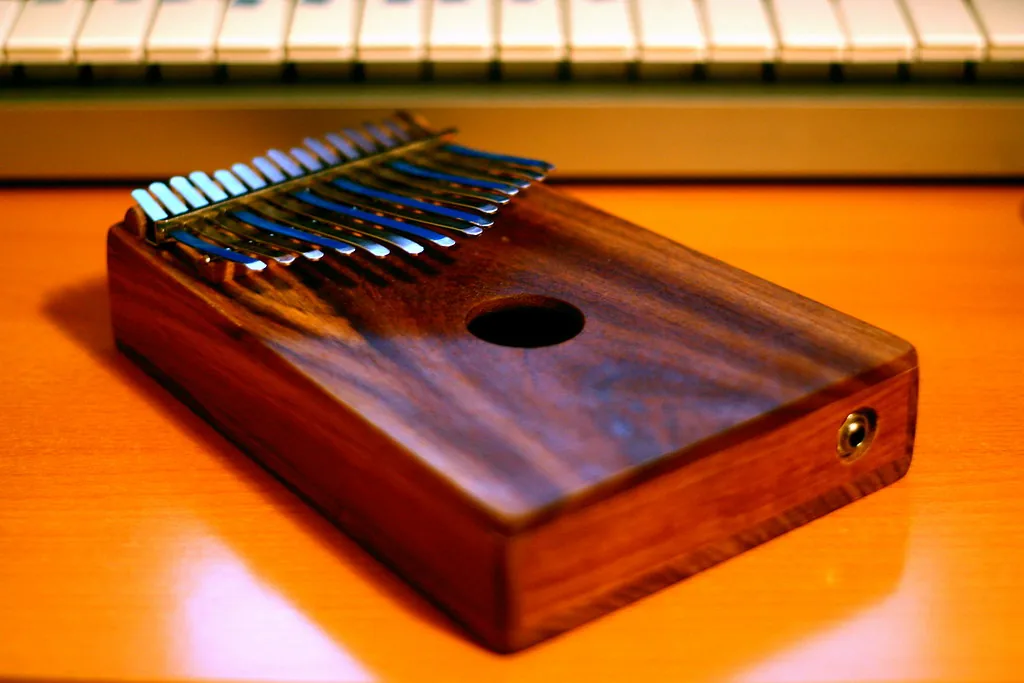
As you think about buying your musical instrument, you may be wondering which kalimba to choose. Here, we will help the musician in you find your way through the options available: a wooden or acrylic kalimba, 8 or 17 tines, which tuning, and more.
Note: for this guide, we use the general term “kalimba” to refer to all instruments of a similar type, such as the karimba, mbira, and sansula. Although these terms are often used interchangeably on the web, that usage is technically incorrect. While respecting every culture and its instruments, we are keeping things simple for beginners.
Sommaire
1. Why buy a kalimba?
The first questions you should ask yourself are:
- Why?
- For what purpose?
These questions matter because they will help guide each of your decisions from now on. The answers will also help ensure that you are happy with your purchase.
So why do you want a kalimba? Here are some of the reasons buyers often mention.
- Easy to learn
- For the beauty of the sound
- For relaxation / meditation
- To play popular songs *
- General interest in music
- I saw it in a YouTube video
- Interest in different cultures
- To work on my concentration and memory
* If you want to play popular songs, such as common Western or Eastern songs, you will need to pay close attention to the tuning section.
2. What tuning for your mbira?
One of the first things to decide is how you want your instrument to be tuned. This concept has two parts.
The first, and by far the most important, is the tuning style.
If you want to be able to play familiar songs, such as songs heard on the radio, you will want one that is tuned diatonically. Do not let the word intimidate you: it is not as complicated as it sounds.
Most Western music and instruments have used the chromatic scale for at least several hundred years. It includes the white and black keys: there are twelve notes in each octave, from C to B; seven are white and five are black.
The notes change from one key to another. However, to keep things simple, you can think of the diatonic scale as having only the seven white keys of a piano, because that is how modern kalimbas are made.
So how do you know which one to buy?
In general, the product sheet for the kalimba you are interested in will state which key it is tuned to:
- Key of A
- Key of B
- Key of C
- Key of D
- Key of E
- Key of F
- Key of G
The key of C has become the “international standard” and is therefore by far the most common on kalimbas sold today. It is followed by the key of B and, to a lesser extent, G.
If you need a chromatically tuned kalimba, meaning one that also has the black keys, there are a limited number of options, and none of them is cheap.
3. The tines of your thumb piano
“Tines” refers to the metal keys on the kalimba that you press to produce the notes. (They may also be called “keys,” “teeth,” or “lamellae.”)
The tines are often the least well-detailed features of kalimbas, but they have the greatest impact on your instrument’s sound.
Metal tines
Kalimba keys can be made from different types of metal, with steel variations being the most common. (Some listings simply say “metal,” which does not really tell you much…)
Many kalimbas are made in various countries, such as China, and the parts they are made from may be produced in other countries, such as Germany. This may explain why the naming is not always clear.
For example, the term “ore” refers to raw metal; however, kalimba lamellae are often listed as “steel ore” or “metal ore.” Steel itself is an alloy of iron and carbon, and therefore cannot exist in raw form…
Here are the types of metal most commonly listed for kalimba tines:
- Recycled metal
- Stainless steel
- Carbon steel
- Manganese steel
Each of these metals has different properties that affect the vibration, volume, tone, and playability of the tines.
Because of these differences, as well as the inherent differences between metal alloys, such as the percentage of carbon or added materials, details of which are never disclosed, it is almost impossible to know what sound the tines will produce simply by reading a kalimba’s specifications.
It is recommended that you listen to videos of various kalimbas using these types of tines in order to determine which type of metal you prefer.
Tine spacing
In addition to the type of metal, you should also consider the spacing between the keys.
Closely spaced lamellae will be harder to play for people with broad thumbs or poor coordination, and may be better suited to children or people with slim fingers.
However, if the tines are spaced too far apart, it can be difficult to play chords, that is, to strum two neighboring lamellae side by side.
Number of tines on your kalimba
Most kalimbas sold today have 17 tines. Some, such as the original Hugh Tracey kalimba, have 15. Others have 12 or 10, or even nine, eight, or seven. (You can probably find almost any number of keys.)
Between 15-key and 17-key kalimbas, there is not much difference. The two extra lamellae you get with 17 keys are rarely used, but they are nice to have when you need them.
Some people buy 10-key kalimbas to solve the issue of tine spacing or because they are considered easier for beginners. While the first argument may be valid, the second is something of a misconception. As with a piano, having more keys gives you more options; however, the concepts and skills needed to play remain fundamentally the same.
Seven- and eight-key kalimbas are generally not used to play popular songs, but they are often ideal for relaxation.
4. What type of kalimba?
Few people would dispute the instrument’s “cool” factor. Intriguing and enchanting, it instantly attracts many people. However, certain style-related considerations can affect which kalimba you choose and how it resonates.
Resonator box or flat-board kalimba
One of the first things you will probably notice when looking at kalimbas is that some have a hole and others do not.
Resonator boxes tend to sound louder, especially with smaller tines. (The kalimba remains a relatively quiet instrument.)
Solid-body kalimbas, also called flat-board kalimbas, are generally quieter than the others, but their volume is more even between high and low notes. (On some resonator kalimbas, the high notes can sound almost “dead.”)
With less wood, flat-board kalimbas are generally lighter and thinner.
Resonator boxes also allow you to produce the “wah-wah” sound sometimes heard, and the sound can be amplified further by covering the holes at the back of the instrument.
What wood should my instrument be made from?
Kalimbas are generally made of wood. Although the type of wood used can affect the tone to some extent, its effect is felt more in the resonance, meaning how long the keys vibrate and therefore produce sound.
In general, the harder the wood, the more resonance the kalimba will have, because sound waves will bounce off the wood rather than being absorbed by it.
Here are some of the most commonly used woods, ranked by estimated hardness from highest to lowest:
- Rosewood
- Sandalwood
- Maple
- Bamboo
- Koa / Acacia koa
- Walnut
- Camphor
- Birch
- Mahogany
- Spruce
5. What price for a kalimba?
Most kalimbas are sold in a price range from €30 to €55, making them one of the most accessible musical instruments. (Models that can be connected to an amplifier via a jack socket cost around €65.)
Generally, the type of wood is the main price factor.
Are you having acoustic problems with your kalimba? In that case, read our tutorial on how to eliminate buzzing. You will then be able to play your instrument from Africa with peace of mind.