
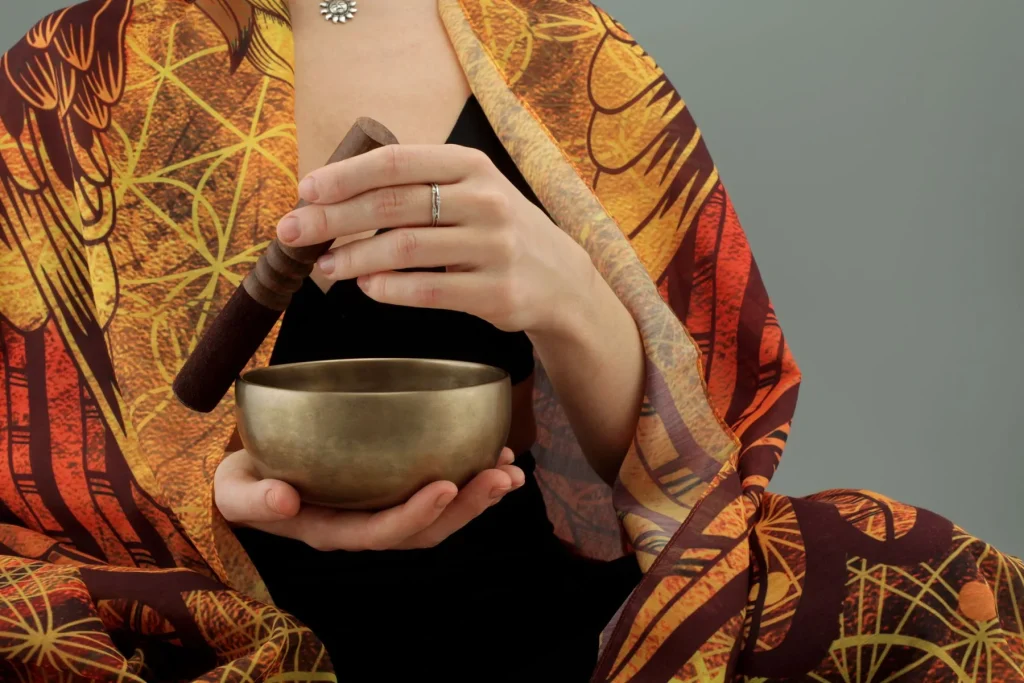
Starting out with a Tibetan singing bowl can be confusing. Many people wonder what to do to obtain that harmonious sound, a symbol of inner peace. If your instrument stays silent, do not panic!
With 10 years of experience in sound therapy, I have identified the most common mistakes. Poor posture or an imprecise technique is often enough to block the vibrations. This article guides you step by step.
Discover two key methods: a light strike and circular rubbing. Once mastered, they release unique benefits: deep meditation, energetic cleansing, and instant relaxation.
Ready to transform your practice? Follow these tips to avoid beginner mistakes and share this wisdom with your loved ones.
Sommaire
Understanding the Tibetan singing bowl and how it works
The traditional instruments used in meditative practices have unique characteristics. Their composition and shape directly influence their ability to produce harmonious sounds.
What is a Tibetan singing bowl?
Originating in the Himalayas, these sacred objects are made from an alloy of seven metals. Each metal represents a celestial body:
| Metal | Symbol |
|---|---|
| Gold | Sun |
| Silver | Moon |
| Copper | Venus |
| Iron | Mars |
| Mercury | Mercury |
| Tin | Jupiter |
| Lead | Saturn |
This particular combination creates rich, deep vibrations. The hemispherical shape naturally amplifies sound waves.
How are vibrations and sounds produced?
The acoustic phenomenon is based on the stick-slip principle. When the mallet rubs against the rim, it alternates between gripping and sliding.
Three factors determine sound quality:
- The roughness of the surface
- The pressure applied
- The rotation speed
The frequencies produced generally range from 110 to 660 Hz. This range corresponds to the fundamental tones most beneficial for relaxation.
Unlike crystal models, metal versions produce more complex harmonics. The choice of accessories therefore plays a key role in the sound experience.
Tibetan singing bowl: what should you do if the bowl does not sing?
An instrument that does not produce the expected sound can be discouraging. Yet a few technical adjustments are often enough to solve the problem.

Common beginner mistakes
According to experts, 85% of difficulties come from poor handling. Here are the main causes:
- Incorrect angle: the mallet should form a 45 degree angle with the rim.
- Excessive pressure: pressing too hard smothers the vibrations.
- Unsuitable speed: movement that is too slow or too fast alters resonance.
- Finger position: holding the object too firmly limits sound waves.
- Noisy environment: background noise masks the harmonics.
Bowl quality: a decisive factor
An authentic handcrafted model can be recognized by several criteria:
- Resonance: at least 45 seconds for a sustained sound.
- Thickness: uniform walls ensure even vibration.
- Finish: marks from hand forging guarantee authenticity.
Beware of low-end steel counterfeits! They produce short, metallic sounds. To compensate for a defective model, use a resonator cushion that amplifies vibrations.
Methods for making your Tibetan singing bowl sing
Mastering harmonious sounds requires precise technique. Two main approaches release deep vibrations. Here is how to perform them properly.
The rubbing technique: step by step
This method creates sustained sound waves. Follow this process:
- Position the mallet at a right angle (90 degrees) against the rim
- Apply steady but light pressure
- Make a circular movement at 2 rotations per second
- Maintain the circular motion without interruption
Optimal rubbing produces a continuous hum. For beginners, start with a reduced speed (1 rotation per second).
The striking technique: simple and effective
Ideal for short, intense sounds:
- Strike 1 cm below the upper rim
- Use the flat side of the stick
- Gliding variation: let the mallet rebound
A dry strike gives a clear tone, while the gliding version adds harmonics. Alternate between the two to obtain varied effects.
Tips for amplifying vibrations
Increase resonance with these solutions:
| Method | Impact |
|---|---|
| Marble surface | +30% sound duration |
| Resonator cushion | Improves low frequencies |
| Water in the bowl | Creates unique modulations |
In cold weather, slightly increase the pressure. Metal vibrates less at low temperatures. A firmer movement compensates for this difference.
How to hold your bowl properly and choose your accessories
Sound quality depends as much on your gestures as on the equipment you use. An ideal posture and suitable accessories transform the acoustic experience.
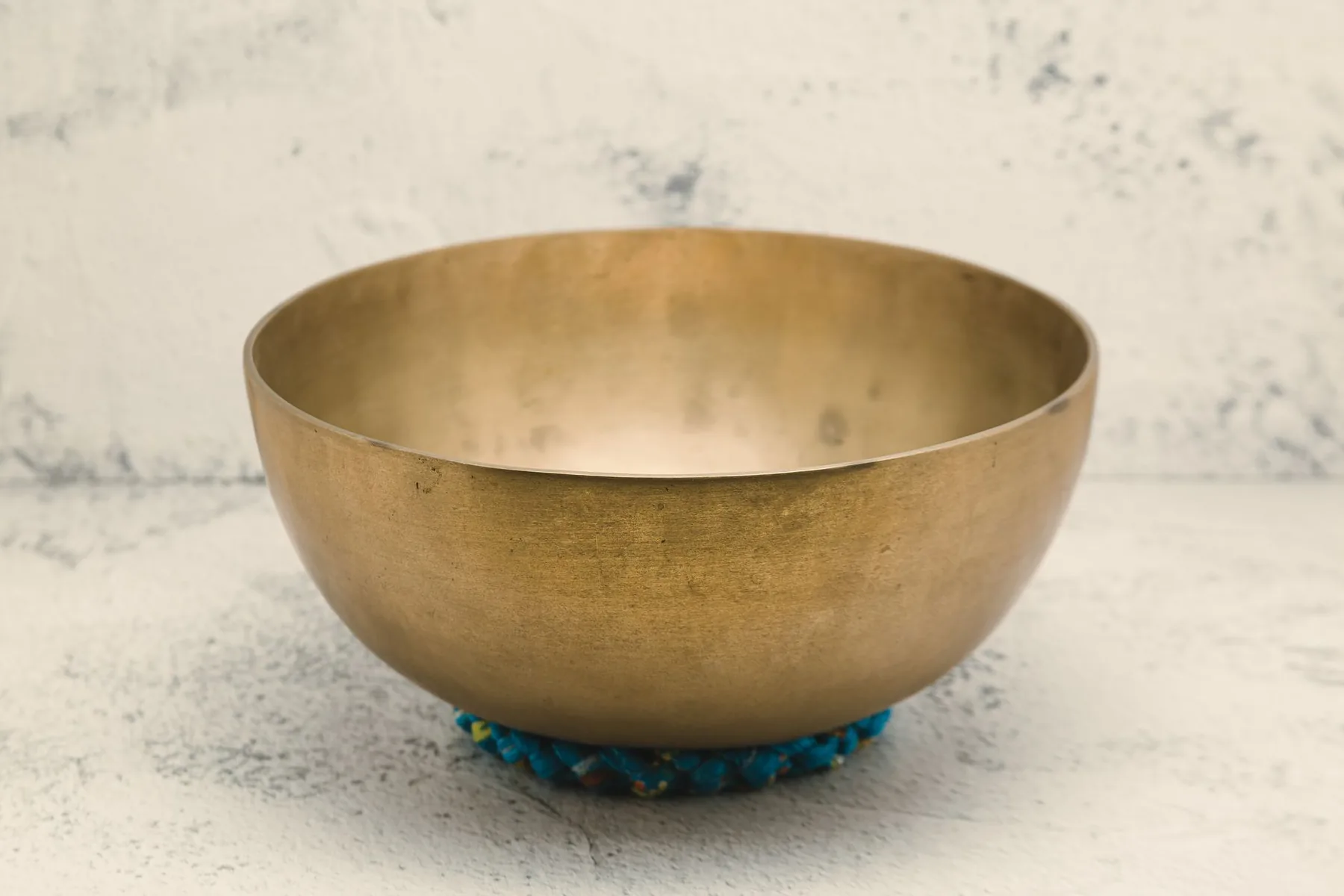
The ideal posture for better resonance
Place the instrument on the palm of your non-dominant hand. Your fingers should be slightly spread, without gripping. This position allows vibrations to circulate freely.
For longer sessions, an ergonomic memory-foam cushion is recommended. It stabilizes the object and reduces muscle fatigue. According to Qi Gong principles, this technique supports energy circulation.
Stick vs. mallet: which should you use?
The choice depends on the size of your instrument:
- Stick (one third of the diameter): ideal for models under 15 cm
- Mallet (150 to 200 g): best for versions of 20 cm and above
The materials also influence the sound:
| Accessory | Advantage |
|---|---|
| Boxwood handle | Greater durability |
| Leather covering | Warm, deep sound |
A gradual break-in period refines the surface of new accessories. Favor gentle circular movements to adapt the equipment to your practice.
Optimizing the use of your Tibetan singing bowl
The art of harmonious sounds improves with suitable practice. For optimal results, adjust the ideal duration and explore different tones according to your needs.
The ideal session length
An effective session varies according to the goal:
- Relaxation: 10 to 15 minutes (432 Hz frequency)
- Energizing: 5 to 7 minutes (528 Hz for regeneration)
Chronobiology recommends the 11 a.m. to 1 p.m. window to stimulate creativity. Avoid prolonged exposure above 90 dB.
Varying sounds according to your needs
Adapt the vibrations to your state:
- Migraines: low, slow sounds (110 Hz)
- Insomnia: gentle harmonics (320 Hz)
Use a journal to note your body’s reactions. Alternate between left and right hand to balance energies.
The benefits of the Tibetan singing bowl for body and mind
Sound vibrations act as a bridge between the physical and the mental. A NIH-indexed review highlights potential effects on mood, tension, and well-being, while stressing that more research is needed.

| Effect | Impact |
|---|---|
| Alpha-wave stimulation | Improves creativity |
| Autonomic nervous regulation | Reduces anxiety |
| Meditative enhancement | Deepens relaxation |
In speech therapy, these instruments may support auditory rehabilitation. Their use can complement cognitive behavioral therapies.
Practical applications:
- Fibromyalgia: easing chronic pain
- Pregnancy: mother-child well-being
- Space cleansing: energetic harmonization
Combined with aromatherapy, the effect may be amplified. Discover more applications in this research overview.
These age-old techniques meet modern body and mind needs. Add them to your routine for overall balance.
Conclusion
Exploring the power of sound vibrations opens unexpected doors. With regular practice, you will learn to unlock the full potential of your instrument. The techniques shared here support lasting results.
Beware of industrial copies that alter the experience. An authentic handcrafted tool amplifies the therapeutic effects. Share your discoveries with our passionate community.
The benefits for the body and mind reveal themselves gradually. To go further, discover our tutorial videos. Your journey toward harmony begins now.
FAQ
What is a Tibetan singing bowl?
Why does my instrument not resonate properly?
How can I improve my instrument’s resonance?
What is the difference between the rubbing technique and the striking technique?
How do I choose the right accessory for my instrument?
How long should a session last for optimal effects?
Can this instrument be used for different practices?
Source Links
- https://instruments-du-monde.com/en-us/blogs/tibetan-singing-bowl/how-to-use-a-tibetan-singing-bowl-techniques-instructions
- https://www.healthline.com/health/dangers-of-singing-bowls
- https://www.uclahealth.org/news/article/what-sound-therapy-and-could-it-benefit-your-health
- https://instruments-du-monde.com/en-us/blogs/tibetan-singing-bowl/how-to-use-a-tibetan-singing-bowl-techniques-instructions
- https://instruments-du-monde.com/en-us/blogs/tibetan-singing-bowl/everything-you-need-to-know-about-tibetan-singing-bowls
- https://instruments-du-monde.com/en-us/blogs/tibetan-singing-bowl/how-to-use-a-tibetan-singing-bowl-techniques-instructions
- https://www.medicalnewstoday.com/articles/sound-baths
- https://instruments-du-monde.com/en-us/blogs/tibetan-singing-bowl/how-to-use-a-tibetan-singing-bowl-techniques-instructions
- https://biologyinsights.com/how-to-use-a-tibetan-singing-bowl/
- https://instruments-du-monde.com/en-us/blogs/tibetan-singing-bowl/how-to-use-a-tibetan-singing-bowl-techniques-instructions
- https://www.mindbodygreen.com/articles/singing-bowl
- https://pubmed.ncbi.nlm.nih.gov/37532602/
- https://www.britannica.com/science/sound-physics
- https://health.clevelandclinic.org/sound-bath
- https://en.wikipedia.org/wiki/Standing_bell
- https://pmc.ncbi.nlm.nih.gov/articles/PMC5871151/
- https://www.masterclass.com/articles/how-to-use-a-singing-bowl
- https://www.verywellmind.com/what-is-a-sound-bath-5214804
- https://pmc.ncbi.nlm.nih.gov/articles/PMC9955072/