

For thousands of years, Tibetan singing bowls have accompanied spiritual and therapeutic practices. These ancestral instruments, forged from an alloy of seven metals, generate deep vibrations. Their sound resonates far beyond a simple melody.
Modern science confirms their impact on the human body. Since our organism is made up of 65% water, it becomes an excellent conductor for these sound waves. A session can induce a state of deep relaxation, close to meditation.
Buddhist monks were already using them 5,000 years ago. Today, their uses extend to stress management and energetic harmonization. To discover how they are traditionally made, explore their artisanal secrets.
Each emitted frequency acts differently on our being. This unique interaction opens the door to an extraordinary sensory and therapeutic experience.
Sommaire
The mystical origin of Tibetan singing bowls
These sacred instruments find their origin in ancient shamanic traditions. The earliest traces go back 5,000 years in the Himalayas, where they first served as vessels.
The Bon religion, practiced before Buddhism, was already using these objects in rituals. Their unique composition associates seven metals with celestial bodies:
| Metal | Celestial body | Property |
|---|---|---|
| Gold | Sun | Vital energy |
| Silver | Moon | Intuition |
| Copper | Venus | Harmony |
| Iron | Mars | Strength |
| Tin | Jupiter | Expansion |
| Lead | Saturn | Stability |
| Mercury | Mercury | Communication |
“Each metal vibrates at a specific frequency, creating a cosmic symphony.”
The Silk Road spread this knowledge across the world. Archaeologists have found examples in Nepalese monasteries, testifying to their importance.
In the 1980s, Peter Hess introduced these instruments to the West. This German physicist studied their effects on well-being, marking a turning point.
Today, their making still respects ancestral techniques. A know-how that crosses time to connect us with ancient wisdom.
The vibrational healing power of Tibetan singing bowls
A vibrational symphony comes into resonance with our biology. These instruments create a bridge between physics and energy work. Their secret lies in their precise interaction with our cells.
How vibrations act on the body
The phenomenon of sympathetic resonance explains the physiological effects. Sound waves stimulate the water molecules contained in our tissues. This action produces a deep cellular massage.
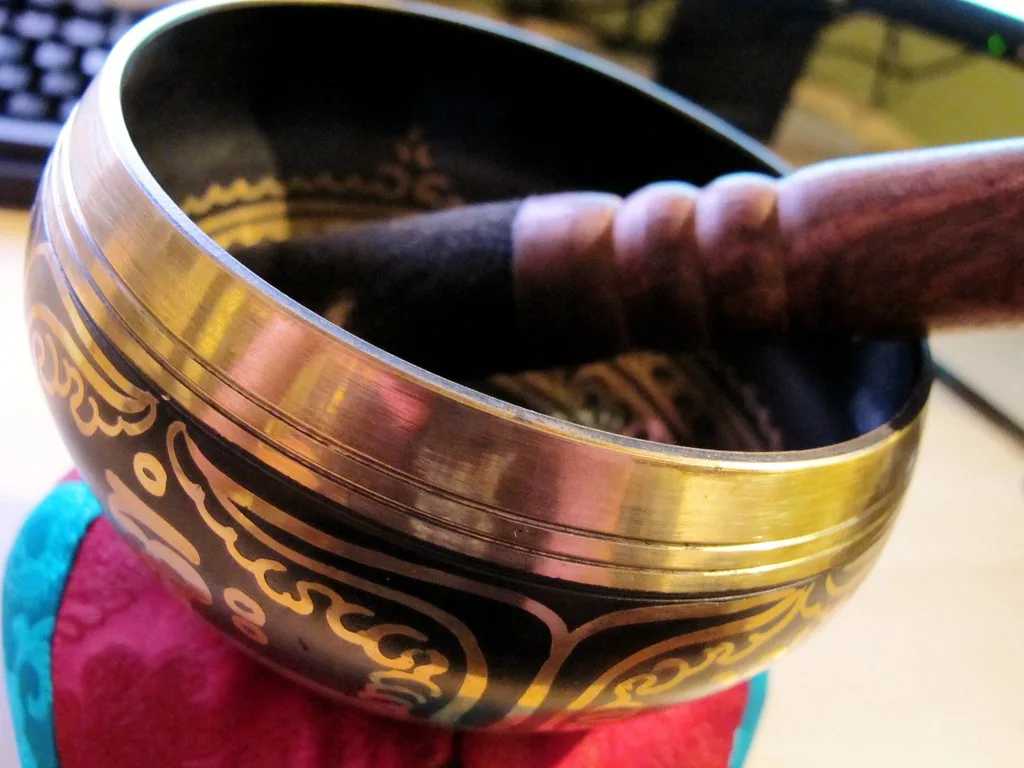
Research from the University of Toronto confirms these mechanisms. After 15 minutes of exposure:
- 23% drop in cortisol, the stress hormone
- Improved lymphatic circulation
- Synchronization of brain waves in alpha mode
Each tissue responds differently to frequencies:
| Body tissue | Optimal frequency | Main effect |
|---|---|---|
| Muscles | 110 Hz | Release |
| Bones | 172 Hz | Stimulation |
| Fascia | 148 Hz | Unwinding |
The impact on chakras and vital energy
Ayurvedic medicine describes 7 major energy centers. Each vibrates at a specific frequency that bowls can stimulate.
“Aligning the chakras restores overall balance, like perfectly tuned strings.”
Typical protocol for a harmonization session:
- Position the bowl near the relevant chakra
- Produce sounds for 3 to 5 minutes
- Let the resonance fade for 1 minute in silence
Contraindications remain rare, but they are important to know. Intensive use should be avoided in cases of pacemakers or advanced pregnancy. A qualified therapist will know how to adapt the session.
Using Tibetan singing bowls in meditation and therapy
The fusion of tradition and innovation gives rise to unique techniques. These sacred instruments are now integrated into contemporary protocols, combining spirituality and science.
Meditation techniques with a singing bowl
Ten minutes a day is enough to obtain tangible results. Place the instrument at heart level, then make it sing with a steady circular motion.
The sounds produced synchronize brain waves in alpha mode. This state encourages deep relaxation, ideal for clearing the mind.
Sound massage and energetic purification
The Peter Hess method revolutionizes the therapeutic approach. The practitioner moves the bowl around the body, at a distance of 10 cm.
Three combined effects occur:
- Vibration of muscle tissue
- Stimulation of the lymphatic system
- Harmonization of energy centers
“Massage through sounds acts like a vibrational scanner, revealing areas of tension.”
Sound therapy and its modern applications
In Germany, some clinics reimburse these sessions. In Lyon, a pediatric program uses their soothing power in oncology.
Innovative workplaces use them to:
- Reduce stress in a few minutes
- Improve concentration
- Create a harmonious atmosphere
Bowls tuned to 432 Hz are gaining popularity. This specific frequency is said to strengthen therapeutic effects, according to the latest research.
The scientifically proven benefits of Tibetan singing bowls
Modern research validates what traditions have known for centuries. A meta-analysis published in the Journal of Evidence-Based Integrative Medicine examines 17 clinical studies. The results show notable improvements in overall well-being.

Anxiety decreases by 41% after regular sessions. Sleep improves for 33% of participants. These figures prove their effectiveness against everyday stress.
At Sainte-Périne Hospital in Paris, these instruments accompany palliative care. Patients report significant relief from pain. Biomarkers, such as salivary cortisol, confirm these observations.
“Vibrations act as a natural regulator of the nervous system.”
A randomized double-blind study of 150 people reveals key mechanisms:
- Stimulation of the vagus nerve
- Increase in alpha brain waves
- Reduction in inflammatory markers
The WHO has officially recognized this practice since 2019. It now includes it among complementary medicines. To explore these effects further, discover their therapeutic applications.
Research prospects include trials on Parkinson’s and Alzheimer’s disease. Early data show improvements in mood and motor function. A gentle revolution for the body and mind.
How to choose your ideal Tibetan singing bowl
Finding the perfect instrument calls for a thoughtful approach. Several essential criteria guide this personal choice. Size, material, and resonance play a key role.

Selection criteria: size, material, and resonance
Diameters range from 8 cm, for higher pitches, to 40 cm, for lower tones. For beginners, a weight between 800 g and 1.2 kg offers a good balance. Always test the duration of the resonance: 45 seconds minimum.
Here are the features to compare:
| Criterion | Recommendation | Impact |
|---|---|---|
| Size | 12 to 22 cm | Versatility |
| Weight | 800 g to 1.2 kg | Comfort |
| Resonance | 45 seconds or more | Therapeutic effect |
7-metal bowls vs. quartz crystal bowls
Traditional metals offer a rich and complex vibration. Their price varies from €80 to €300. Crystal, more precise in frequency, costs between €120 and €600.
Main differences:
- 7 metals: warm, deep sound
- Crystal: clear, precise tone
- Metals: artisanal production
- Crystal: industrial production
“A good bowl sings with your soul before it ever touches your lips.”
For a complete guide to buying one, consult our selection of certified bowls. Choose brands such as Himalaya Crafts for guaranteed authenticity.
Always test the instrument before buying. Its primary function should guide your decision: personal meditation or therapeutic use. Your immediate feeling remains the best indicator.
Conclusion
The benefits of these ancestral instruments now resonate in the modern world. Stress reduction, improved sleep, and energetic harmonization are now validated by science.
This balance between tradition and research opens promising perspectives. Some European hospitals already integrate these techniques to complement conventional care.
For a first experience, take part in an introductory workshop. Certified practitioners will guide you toward optimal use, such as those recommended by Nandara.
“The union of sound and spirit transcends time, offering deep peace.”
Dare to explore this thousand-year-old practice. Your path toward well-being begins with a simple vibration.
FAQ
Where do Tibetan singing bowls come from?
How do vibrations influence the body?
What is the effect on the chakras?
Can you use a Tibetan singing bowl for meditation?
What benefits are scientifically recognized?
How do you choose between a metal bowl and a crystal bowl?
How long does a typical session last?
Source Links
- https://en.wikipedia.org/wiki/Standing_bell
- https://pmc.ncbi.nlm.nih.gov/articles/PMC5871151/
- https://pubmed.ncbi.nlm.nih.gov/40352083/
- https://www.learnreligions.com/buddhist-holidays-449918
- https://instruments-du-monde.com/en-us/blogs/tibetan-singing-bowl/tibetan-singing-bowl-origins
- https://www.mindbodygreen.com/articles/sound-bath
- https://instruments-du-monde.com/en-us/products/tibetan-singing-bowl-energy-healing
- https://www.uclahealth.org/news/article/what-sound-therapy-and-could-it-benefit-your-health
- https://www.yogabasics.com/connect/yoga-blog/sound-baths/
- https://instruments-du-monde.com/en-us/products/tibetan-singing-bowl-energy-healing
- https://journals.sagepub.com/doi/abs/10.1177/2156587216668109
- https://instruments-du-monde.com/en-us/blogs/tibetan-singing-bowl/tibetan-singing-bowl-how-to-choose
- https://instruments-du-monde.com/en-us/blogs/tibetan-singing-bowl/tibetan-singing-bowl-frequency-hertz
- https://en.wikipedia.org/wiki/Standing_bell
- https://instruments-du-monde.com/en-us/products/tibetan-singing-bowl-energy-healing
- https://journals.qmu.ac.uk/approaches/article/view/320